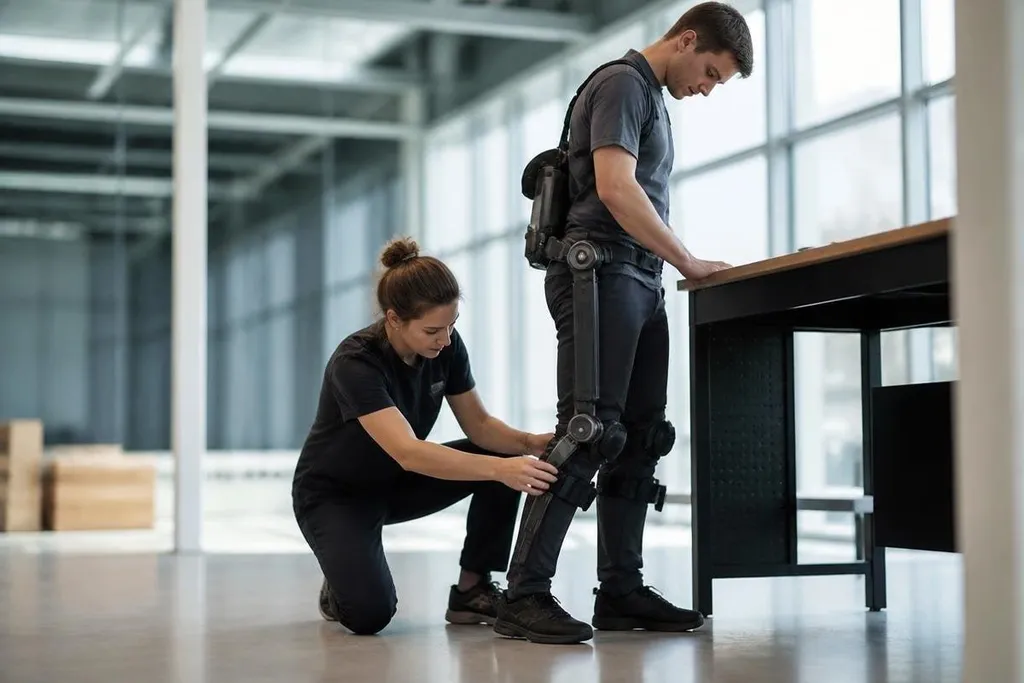
A robotic exoskeleton can add motor torque to a person’s hip, knee, or back. The hard part is matching that help to a moving body without pushing at the wrong time.
Quick read
- Sensors must detect the wearer’s movement before the motor adds force.
- A lighter frame can matter more than a larger battery.
- Buyers need proof from the job site, not a walking demo alone.
What the robot has to sense
An exoskeleton sits between a person and the task. It needs to know when a joint is moving, how fast it is moving, and whether the wearer wants to speed up, slow down, or stop.
Most designs use sensors at the joints, pressure sensors in the foot, or motion sensors on the frame. A controller reads those signals and sets the motor’s torque, which is the turning force at the joint. That loop has to run quickly because a delay can make the frame feel like it is fighting the wearer.
Fit changes the quality of that control. A knee joint on the robot must stay close to the wearer’s knee as the leg bends. If the two joints drift apart, the frame can press into the leg or pull against the body. A few millimeters can matter when the wearer repeats the same motion for hours.
Motors are only one part of the system
A larger motor can add more force, but it also adds weight, heat, and power use. Those costs sit on the wearer’s body, so a motor rating alone tells you little about the work a person can do during a full shift.
The frame, battery, wiring, control software, and padding all affect the result. A battery mounted near the waist may feel better than the same battery mounted on the lower leg, because weight on the leg makes each step harder.
Cable routing matters too. A cable that rubs against a joint can turn a clean lab setup into a daily maintenance problem.
New exoskeletons will likely need better adjustment for different bodies and tasks. Walking, lifting, climbing stairs, and holding a bent posture each produce different joint loads, so one fixed assistance setting cannot fit every job.
Where the evidence is still thin
A short demonstration can show that an exoskeleton moves with a person. It cannot prove that the device reduces fatigue across a full work period, keeps its fit after repeated use, or works for people with different heights and movement patterns.
That gap matters to an operations manager. A device that helps for ten minutes may still fail if workers need frequent battery changes, if the frame limits access to shelves, or if putting it on takes too long at the start of a shift.
Safety needs the same level of care. The system should stop adding force when a sensor fails, a battery reaches its limit, or the wearer presses an emergency control. The stop must be easy to reach while wearing gloves and moving near equipment. A safety label cannot replace a clear test of those cases.
A vendor’s exoskeleton claim needs the model, assist level, battery time, and test setting beside it. Reports from Robot 24 can give you those details before you compare a system’s price, fit, and safety record.
What to check before a purchase
Use this short list when a supplier shows you a powered exoskeleton:
- Task fit: Ask which joint the system assists and which motions it supports.
- Wear time: Get the rated battery period for the exact assistance mode you plan to use.
- Adjustment: Check the time needed to fit the frame to each worker and change between tasks.
- Failure response: Test what happens when a sensor, motor, or battery stops working.
- Work evidence: Ask for results from the same type of job, with the test length stated.
- Service plan: Confirm who replaces padding, cables, batteries, and joint parts.
What buyers should expect next
A useful product will make its limits easy to measure. That means reporting battery time under a named load, assistance at each joint, frame weight, fitting time, and the task used for the trial.
I’d wait for that information before paying for a large deployment. A lighter frame with steady control and a quick fit may help more people than a stronger motor that works for one body size and one carefully prepared demo.
The buying decision should rest on a repeatable work test: the same task, the same shift length, and a clear record of stops, charging, comfort, and output.